Looking over the reviews on Goodreads as I prepare to post this review, I wonder what my problem is. Why didn't I get spine-tingles on the final page? I am forever in pursuit of that 16-again feeling that the best stories can give you. Have I lost that and become a victim of my own snarky reviewer's inner monologue?
I honestly don't know.
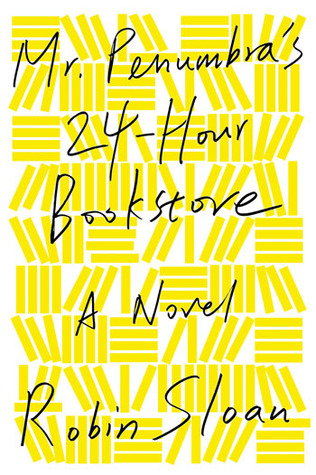
I see what Robin Sloan is trying to do. He's trying to write a clever, self-referential, nerdtastic ode to books and stories.
A noble pursuit.
And it is self-referential. But it's just not as clever as it thinks it is. As for nerdtastic, this nerd was somewhat unimpressed.
It's narrator, whose name I truly cannot think of without returning to the novel (Jenner? Jad? Clay? Yes, that's it, Clay), is your friendly San Franciscan Every-manchild, of indeterminate-but-aggressively-under-thirty age, who having lost his job as a graphic designer at a startup called NewBagel (OneWord) comes to make his living in the eponymous bookstore and has an army in implausibly well-connected and well-funded friends.
But, you may be asking, where is the Manic Pixie Dreamgirl? Don't you worry, my hipster friends, Kat the Hot Smart Programmer Chick enters about sixty pages in. As Clenner/Jay/Clad explains to Hot Smart Programmer Chick about his unusual participation in the secret society run out of Penumbra's dusty shop, she replies:
"That's amazing...Google's like a baby compared to that."
And Clay understands that she's even more of a dream girl than he first thought:
That explains it: this girl is a Googler. So she really is a genius. Also, one of her teeth is chipped in a cute way.
Aw. How cute.
Thank God an Average-looking Smart Programmer Chick didn't wander in. The story would never have gotten off the ground.
Kat, btw, is also the only female character of note in this story. A few others make cameos, but they are tokens.
Anyway, a pseudo-mystery plot ensues where Jlad and Kitty Kat pursue some mildly-engaging secrets, meanwhile creating a marriage of true minds between Google and a whole bunch of very dusty books. It's entertaining. But the whole time I just couldn't shake the feeling that in its clever, self-referential tone it believed itself to share a kind of intertextuality with a whole genre of books that are completely out of its league.
Sloan's point is fairly transparent: Books and technology aren't in opposition! They can work together! Sometimes people who read books know even MORE!
But unfortunately what happens is that Sloan undermines his own point. Because when he's trying to invoke Tolkien, Lewis, and even Borges, he's also writing sentences like this:
This is Mat's secret weapon, his passport, his get-out-of-jail-free car: Mat makes things that are beautiful.
And this:
Nobody's looking. I hoist the X high like a mythic sword.
In a book intended for smart people, there is a shocking dearth of complex sentence structure and interesting diction, original writing replaced instead with lists of cliches striving to sound climactic and similes that sound like they're trying to appease childhood readers of T. H. White but don't even come close.
And so Sloan goes on to do what I find that digital apologists-via-print do altogether too often: he oversimplifies. In trying to be clever, his narrator's voice just feels cute and immature. And the solution to his puzzle falls easily out of the sky, funded by his best friend from sixth grade who is now rich because...wait for it: he owns the world's best digital boob creation program.
Because the latent misogyny and female tokenism weren't enough.
I wanted to love this book. I wanted it to be smarter and fresher and more daring. I agree that books and technology aren't in opposition. But Penumbra argues against itself in its derivative simplicity.
You'd be better off picking up Tolkien again if you ask me.
Friday, June 20, 2014
Wednesday, June 11, 2014
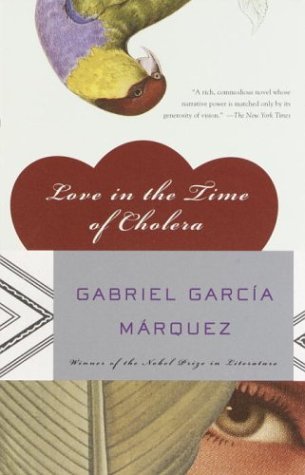
Love in the Time of Cholera
Reading this book was a struggle. I've tried twice before, and failed to get past the first forty pages.
I'm glad that I read it.
But reading it felt a bit like I imagine it feels for people who don't like to read, to read.
The sumptuous prose, the sensual Colombian culture, the hyperbolic, almost mythic characters -- you've heard about it before. And even after much reflection, I still can't put my finger on why I don't love this book. It is, undeniably, a masterpiece.
I certainly appreciate it.
I understand why people love it. But I don't. I'd love to hear from people who do love it about what it means to them.
I will say, though, that this book moved me. In really rather painful ways. So I guess that might be part of it.
I think this is a novel about the ravages of passionate longing and the redemptive possibilities that remain in that longing even as it ravages. Its spurned lover, Florentino Ariza, who spends his life in affairs with woman after woman whom he cannot love from beneath the shadow of his adored Fermina Daza, becomes the mythic, and yet somehow simultaneously pathetic, champion of the kind of love that is so consuming, so controlling, so paralyzing, that it can be mistaken for cholera.
Their story is about the costs of idealizing the sharp passion of young love and the pain of remembering the past and the times when you were happiest:
Despite the perpetual rain, the sordid merchants, and the Homeric vulgarity of its carriage drivers, she would always remember Paris as the most beautiful city in the world, not because of what it was or was not in reality, but because it was linked to the memory of her happiest years.
As Florentino watches from afar, Fermina lives married life through cycles of alternating rage and seeming wedded bliss. Nothing really makes sense in this story. And yet there is a certain kind of revelatory wisdom about human nature in the intense nonsense of its characters' foibles and indiscretions.
In the end, (spoiler alert!), Florentino Ariza is faithful to Fermina Daza, faithful through his myriad acts of unfaithfulness and her marriage and "fifty-three years, seven months, eleven days and nights," and Garcia Marquez does grant them their own kind of happily ever after, fetid and sweltering though it may be, as after a lifetime of longing, they finally drift eternally together down a river to La Dorada, unable, and yet also undesiring, to disembark because of the cholera flag the ship's captain has chosen to fly.
This book is by no means prescriptive for how we ought to love. But it is absolutely descriptive of the ways that we do love. The ways that what Garcia Marquez calls "intrepid love" has a life and will of its own, and the ways it can change us irrevocably and completely without our control.
Love in the Time of Cholera is worth it. But its not easy. And maybe that is precisely the point.
Tuesday, May 27, 2014
Bark, stories by Lorrie Moore
Ever since I finished Lorrie Moore's most recent collection of short stories over a month ago, I haven't been able to get the following moment out of my head:
In the final story of the collection, "Thank You for Having Me," a mother attends the wedding of her now-15-year-old daughter Nickie's former babysitter.
As they wait for the ceremony to begin, Nickie, whom her mother describes as "both keen observer and enthusiastic participant in the sartorial disguise department" remarks:
"I can't believe Maria's wearing white."
I shrugged. "What color should she wear?"
"Gray!" Nickie said immediately. "To acknowledge having a brain! A little grey matter!"
A little grey matter indeed. All too many of Moore's characters seem lacking it. They marry, and remain married, nonsensically. They divorce yet still go on vacation together, date women even though they know them to be crazy, meet for romantic weekends in Paris and leave one another alone on a sidewalk cafe without indication of what their relationship might be, now or ever.
They converse without communicating:
"All husbands are space aliens," said her friend Jan.
"God help me, I had no idea," said Kit.
***
"We cheat the power of time with our very brevity!" he said aloud to Bekka, feeling confident she would understand, but she only just kept petting the cats.
***
"I don't think you should go," he announced.
"I'm going," she said.
"We'll be giving the children false hope."
"Hope is never false. Or it's always false. Whatever. It's just hope."
Fragmented, at times shallow, always bleak, this collection haunts me.
I loved it.
Moore's characters are the people who make up my Twitter feed and my Facebook friends. (If you, dear reader, are either, I assure you -- I don't mean you. I mean those other followers and friends, obvi.) They are the bits and pieces that all of our lives are reduced to while, increasingly, the only reflections of ourselves and our purpose that we really see are nothing more than selfies.
Her stories are tales from a world of online dating where it's totally acceptable and expected that men will exploit women and bad movies about weddings that are masquerading as feminist comedy and weddings that mean more than marriages and require their own websites and hashtags.
Her stories become the easy meaninglessness of modern life all boiled down into tales that makes their real emptiness stand out in stark relief against what stories used to mean, and might, if Moore has any say in it, one day mean again.
In the end of "Thank You for Having Me," the woman observes:
Ian played "Here comes the Bride." The bridesmaids were in pastels: one the light peach of baby aspirin; one the seafoam green of low-dose clonazepam; the other the pale daffodil of the next lowest dose of clonazepam. What a good idea to have the look of Big Pharma at your wedding. Why hadn't I thought of that? Why hadn't I thought of that until now?
How brilliant. The idea that we anesthetize ourselves with psychotropic drugs and bridesmaids' dresses alike -- each woman gets to pick her own style and shade! what a fantastic celebration of her individuality! -- these are the stories Moore is telling. But her caustic tone and precise prose do not allow us to accept these stories.
Instead, they challenge them. Where is the real meaning? Is there a future ahead of us where hope does indeed matter again? Will we make sense, will we communicate, will we empathize, or are we doomed to remain safely clad in the trappings of individuality that are, in reality, the uniforms of conformity?
I hope we will.
Whatever. It's just hope.
Sunday, April 6, 2014
Ode to Tana French
I've talked about Irish writer Tana French before, but as I finish up Faithful Place, I just want to mention that if you haven't yet encountered her novels, you have a treat ahead of you. They are the kind of books that I am jealous that you will be able to encounter for the first time.
In the Woods, in particular, is like Bones + SVU + CSI + Dexter all rolled into one with the intelligence and nuance of a real character-driven novel. It is flawlessly suspenseful, terribly human, and ultimately, moving.
And Rob and Cassie, the detective duo who lead the narrative down its thrilling twists and turns, are some of my perpetually favorite characters, full-stop.
The Likeness, then, comes back to Cassie after In the Woods has ended, and puts her undercover in an enclave of graduate students in English that reminds me of a certain mountaintop School of English that I know of, but with a sinister edge that will keep you up at night.
She's so smart and likable that you'll wish you could materialize her into your real-life best friend, and her story will absorb you like the best books always do.
Oh, and also it's super creepy.
The pleasure of these novels is fully absorbing, and they fall into that category that make me wonder at those few books that get real fame. You could walk down a beach seeing everyone there reading Gone Girl, but these mysteries are more suspenseful, their characters so much more likeable, and the prose -- well, the writing just doesn't even compare.
Oh Tana French, how I love you!
Saturday, March 29, 2014
Beautiful Ruins: DNF
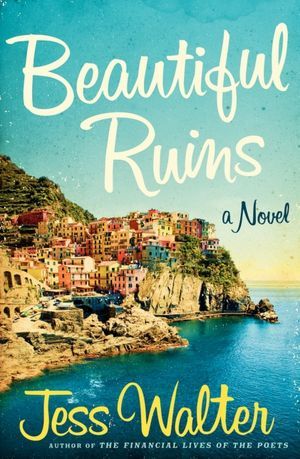
I'm really not sure by what standard Fresh Air's Maureen Corrigan judged Jess Walter's 2012 novel a "literary miracle," but not only did I not find it to be a literary miracle, I didn't even think it was particularly literary.
I found the characters flat and insipid, and the writing, as my friend Mary Ellen noted, like the binding of the book itself, tawdry.
The form, which many reviewers find avant-garde, felt slap-dash, and using Richard Burton and Liz Taylor as characters seemed just lazy.
I didn't finish it. Life's too short.
Sunday, March 2, 2014
Book Club Shout-Out
Book clubs can be tricky for English teachers. We can be a bit...bossy when it comes to the relaxed literary discussion.
But four of my friends humored me this October when we got together at my place and formed what is now known as the Decades Book Club. The five of us span five decades, from twenties to sixties. We are all teachers, most of use are mothers and wives, some of us have cats, all of us live reflective inner lives.
As I told them on Friday, the Decades Book Club is the best thing to happen to me this year.
Here's what we've read, and our take on each.
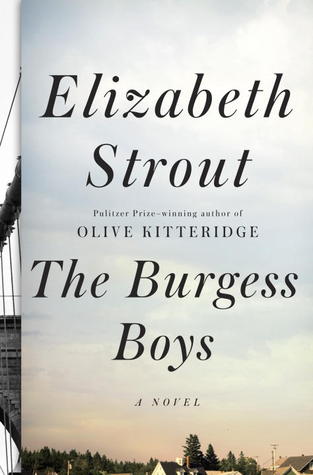
This was my suggestion because I love Olive Kitteridge so much -- and we all did. We are, by nature, a group who loves character-driven literary novels like The Lonely Polygamist and A Prayer for Owen Meany.
We all liked The Burgess Boys. It was a great starting place, and it led to lots of fruitful discussion about family and sibling dynamics. No one we loved as much as old Olive, but certainly worth our time.
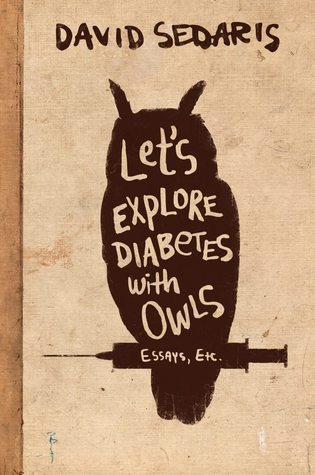
Let's Explore Diabetes with Owls was our least favorite selection. Some of us are big fans of Sedaris, some not so much, but we all kind of felt that he jumped the shark on this collection a bit, exposing new depths of psychological distress and unresolved family issues. (Also he starts waaaay too many paragraphs with "The thing about..." -- "The thing about Hawaii..." "The great thing about sea turtles," "The thing about my unresolved obsessive-compulsive need to pick up trash on the Irish countryside...") His voice is just a bit too navel-gazing to be relatable. This was the only book that some members of the club (cough, ahem, guilty) did not finish.
Though I do really recommend "Loggerheads," if you happen to have a copy lying around.
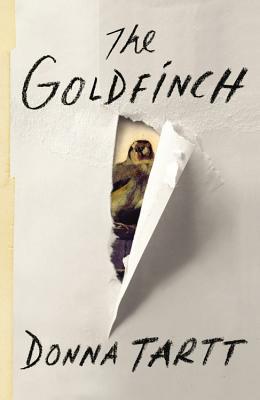
This, dear Reader, is a book to read with a really awesome and committed book club. It is long. Perhaps longer than it needed to be. And I will admit that I might not have finished it without that tiny bit of book-club peer-pressure. Which is so something I never would have admitted before that I needed! I am a Reader-with-a-capital-R! I have a book blog for crying out loud! I don't need wine-lubricated discussions on my Google calendar to get me to read!
The Goldfinch, which, btw, all five of us finished in its entirety, is a tome, but it resulted in my favorite book discussion so far. And that discussion grew into a larger discussion about depression, self-medication, self-deception, and self-sabotage. And art. And philosophies for living and finding meaning.
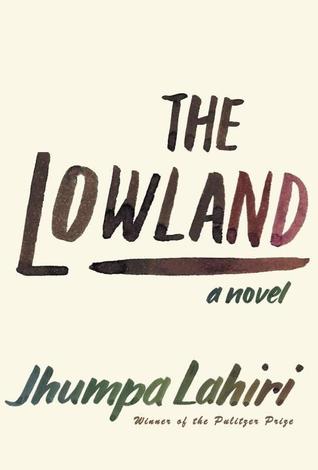
My favorite read of the year. I love everything Lahiri does, though I will admit that it can be a bit uneven. This novel was so beautiful and sad, its characters so real. She had a beautifully detached way of story-telling that makes her voice so moving and yet, somehow, distant, like she is telling some kind of sad fairy tale.
This is the book out of the ones on my list that I would tell you without hesitation to pick up. I read it in a few days and lost myself entirely in its pages. A work of love and sadness. Read it.
Next up: Beautiful Ruins.
I have always been a believer in the ways that books make us better. And I know myself to be so much more fulfilled when I can regularly lose myself to a book.
But as I've said before, reading, and as a result, thinking, can be hard to find time for.
I am beyond thankful for the incredible group of women who have allowed me to find time to think, to connect, to reflect, and most of all, to laugh and to feel so profoundly supported by our shared experience of living meaningfully in the frenzy of modern life.
But four of my friends humored me this October when we got together at my place and formed what is now known as the Decades Book Club. The five of us span five decades, from twenties to sixties. We are all teachers, most of use are mothers and wives, some of us have cats, all of us live reflective inner lives.
As I told them on Friday, the Decades Book Club is the best thing to happen to me this year.
Here's what we've read, and our take on each.
This was my suggestion because I love Olive Kitteridge so much -- and we all did. We are, by nature, a group who loves character-driven literary novels like The Lonely Polygamist and A Prayer for Owen Meany.
We all liked The Burgess Boys. It was a great starting place, and it led to lots of fruitful discussion about family and sibling dynamics. No one we loved as much as old Olive, but certainly worth our time.
Let's Explore Diabetes with Owls was our least favorite selection. Some of us are big fans of Sedaris, some not so much, but we all kind of felt that he jumped the shark on this collection a bit, exposing new depths of psychological distress and unresolved family issues. (Also he starts waaaay too many paragraphs with "The thing about..." -- "The thing about Hawaii..." "The great thing about sea turtles," "The thing about my unresolved obsessive-compulsive need to pick up trash on the Irish countryside...") His voice is just a bit too navel-gazing to be relatable. This was the only book that some members of the club (cough, ahem, guilty) did not finish.
Though I do really recommend "Loggerheads," if you happen to have a copy lying around.
This, dear Reader, is a book to read with a really awesome and committed book club. It is long. Perhaps longer than it needed to be. And I will admit that I might not have finished it without that tiny bit of book-club peer-pressure. Which is so something I never would have admitted before that I needed! I am a Reader-with-a-capital-R! I have a book blog for crying out loud! I don't need wine-lubricated discussions on my Google calendar to get me to read!
Turns out, I really really do.
The Goldfinch, which, btw, all five of us finished in its entirety, is a tome, but it resulted in my favorite book discussion so far. And that discussion grew into a larger discussion about depression, self-medication, self-deception, and self-sabotage. And art. And philosophies for living and finding meaning.
Books are amazing.
My favorite read of the year. I love everything Lahiri does, though I will admit that it can be a bit uneven. This novel was so beautiful and sad, its characters so real. She had a beautifully detached way of story-telling that makes her voice so moving and yet, somehow, distant, like she is telling some kind of sad fairy tale.
This is the book out of the ones on my list that I would tell you without hesitation to pick up. I read it in a few days and lost myself entirely in its pages. A work of love and sadness. Read it.
Next up: Beautiful Ruins.
I have always been a believer in the ways that books make us better. And I know myself to be so much more fulfilled when I can regularly lose myself to a book.
But as I've said before, reading, and as a result, thinking, can be hard to find time for.
I am beyond thankful for the incredible group of women who have allowed me to find time to think, to connect, to reflect, and most of all, to laugh and to feel so profoundly supported by our shared experience of living meaningfully in the frenzy of modern life.
I am better for it.
Friday, December 27, 2013
In One Person by John Irving
*I wrote this review this summer, but never posted it. But if you happen to have a little reading time on your hands, this novel might do the trick. But it's not for everyone -- see below.*
John Irving, I love you so much. But your latest novel, In One Person, is entirely too much about penises.
I mean, you've been writing novels for longer than most of these clowns publishing so-called "literary fiction" these days have been alive. And I love you characters like they are my own friends. And your voice is true and not at all fussy. And your plots are masterful, unexpected, and rarely heavy-handed.
But I just don't know if I can recommend In One Person, as much as I loved it, because of all the penises.
But if you've made it this far in my review, and you're still interested, oh gosh, I loved this book.
It might have been because of the familiar beginning:
A boy with a beautiful mother, an enigmatic lack of a father, a beloved step-father, and a strange New England boarding school faculty-kid upbringing participates in vibrant community theater with an unforgettable grandparent. Fans of THE VOICE will know what I'm talking about.
There's a lot about William Abbott that reminded me of Johnny Wheelwright. At one point, his classmate Delacorte practically echoes Owen Meany word for word:
"I didn't say what your mom looks like," Delacorte insisted. "I just said she was the most beautiful. She's the best looking mom of all the moms!"
I have to imagine these echoes are deliberate on Irving's part, but either way, this novel evoked Owen Meany in an appropriately nostalgic and tender way.
But from those familiar beginnings, William Abbott takes a different path. Much of this story takes place in the small town of First Sister, Vermont, where William comes of age and meets the love of his life, the mysterious librarian, Miss Frost. Miss Frost introduces William to the world of reading, and throughout his life, these books help him to understand himself, others, and his universe:
I raced home from school to read; I raced when I read, unable to heed Miss Frost's command to slow down. I raced to the First Sister Public Library after every school-night supper. I modeled myself on what Richard Abbott had told me of his childhood. I lived in the library, especially on weekends.
See why I liked it?
Meanwhile, he and his best friend Elaine participate in Shakespearean plays and go to school and grow up. And things happen, unexpected things -- they leave First Sister, they live in New York and San Francisco. They face tragedy. But all the while, William always returns home to First Sister, to the wisdom of his family and those novels that helped him grow up.
This novel is about love. It is about different types of love than you or I might experience, and yet they are so recognizable -- that is Irving's gift. He loves people; he loves his characters, who are deeply human in their weirdness, and they are conveyed with such straightforward compassion that this reader could not help but feel ennobled by the end.
And it is a novel about books. About how they help us face things. How they shows us who we are and also allow us to escape from ourselves.
William comes by his creative predilections rightfully -- his grandfather, Grandpa Harry, is renowned for his portrayals of some of Shakespeare's most influential leading ladies. But Grandpa Harry knows some things, and in his infinite wisdom and his infinite strangeness, he tells William:
"Ah, well -- there's people you meet, Bill," Grandpa Harry said. "Some of 'em are merely encounters, nothin' more, but occasionally there's a love-of-your-life meetin', and that's different -- you know?"
It is different. And so is this novel.
Wednesday, August 7, 2013
Two Epic American Tales
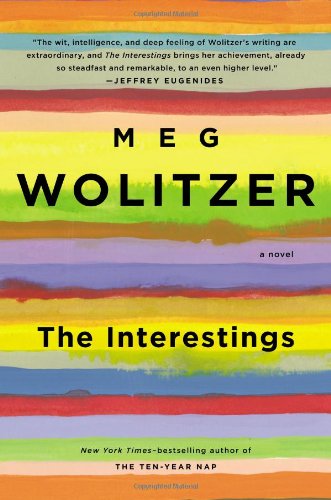
The Interestings is about transformation. The desire for it, the impossibility of it, and the inevitability of it.
It's not as good as Freedom. So start there.
But it's pretty darn close. And I sat down to start reading on a Wednesday when I had nothing else I had to do, and I read 300 pages. And that day became one of my favorite days of the summer. So once you've tackled Freedom, Meg Wolitzer's fresh and moving novel should be next on your list.
You've heard the synopsis by now -- four friends, meet at summer camp, ironically/non-ironically name themselves the Interestings. Some grow up to be more interesting than others.
To me, the best character in this novel is not the protagonist, Jules, but her perpetually-spurned best friend Ethan, who grows up to create a Simpsons-style mega-hit called Figland. Jules may not have, but I loved Ethan.
Jules herself is another story. Jealous to the point of irrationality, she struck me as a less complicated, even less likable Patty Berglund. Which is really saying something.
But Ethan loves her anyway, and I love him for it, and their story becomes the story of all of us growing up through this much more complicated than we ever imagined terrain of adulthood.
Honestly, I do not know why everyone thinks adolescence is so hard. As far as I can tell, from my own (limited) experience & books, real adulthood (We're talking 30's here, people. 20's don't count.) is so much more complex, so much more painful, so much less clear.
And that is what The Interestings is about. It's about how nothing turns out the way we think it will, it's about success and failure, and it's about being loved, and how sometimes, simply being loved just isn't enough.
And it's also about being an adult and losing yourself for a summer's day and 300 pages. Which is a gift.
Middlesex is also about transformation. About the incredible universality and infinite multiplicity of the physical and emotional transformation that we all go through as we grow from children to adults. (Ok, I'm re-granting 20-somethings their adulthood in this second half of this post.)
If you are a book-lover like me who also somehow missed Eugenides' masterpiece when it came out over ten years ago, you are in for an absolutely incredible treat.
Middlesex is a story about a hermaphrodite. But if you are seeking a story about the seedy underside of the transgender world of the early eighties, look elsewhere.
This book is not about a freak-show. It is about how intensely human, and how intensely freakish, each of us is. Even when our hero Cal does find himself in the seedy underside of the trangender world of the early eighties, it is 400 pages into the book, and it somehow becomes so much more about universality than freakishness.
This book is breathtakingly written, flawlessly researched, and deeply moving. It is engrossing enough for a beach read but literary enough for a senior thesis.
Do not miss it.
Tuesday, July 30, 2013
Why I love to hate John Green
I'll admit it, and I don't really mean it -- I'm sure he's a great guy. And he's doing great things in this world and making lots of readers really happy. Or devastatingly sad, as the case may be with the cancer book.
But I kinda love to hate John Green.
A lot of the time, his male protagonists are kind of like mini-John Greens.
But as far as I can tell, the vast majority of John Green's readers are teenage girls.
You see where this could begin to get weird. For example, Augustus, in The Fault in Our Stars, who says things like this:
“Oh, I wouldn't mind, Hazel Grace. It would be a privilege to have my heart broken by you.”
And, regarding cigarettes,
“its a metephor, see: you put the killing thing right between your teeth but you don't give it the power to do its killing.”
Things that, as my venerable and sassy colleague Mary would say, "no teenage boy would ever say."
Augustus is hip-as-in-hipster, and he cares about style, and he's verbal and sensitive and emotionally communicative. And he makes up ridiculous metaphors about cigarettes and mortality that I'm not sure if I don't fully understand or if they actually just don't make any sense.
See? Mini-John Green.
Now, writing a mini-me is all well and good. But Green is putting up this mini-me in front of a massive audience of teenage girls who are longing and aching for Augustus Waters/mini-John Green. And so they close their chapter books, and dry their eyes, and open their laptops because they want more.
And what do they find? Not more Augustus Waters. But more John Green. Who is just similar enough, and who understands their longings for those elusive verbal boys just enough to stand in their place for hour upon hour of obsessive internet trolling.
And so it seems, in some ways, his entire Nerdfighting empire is just in the right place to fulfill those desires. Not in any weird, gross way. Just...just enough for it to feel a tiny bit manipulative.
So this is why I really love to hate John Green. I admit it might be because I'm jealous of what he's been able to accomplish when I am certain that I am just as nerdy and love books just as much as he does.
It might be because those damn "Crash Course" videos are so annoyingly reductive-yet-right all the time, Spark Notes-style.
But I think the real reason is that his writing doesn't feel entirely emotionally honest to me. Because John Green is a grown-up. So he knows exactly what kinds of things sensitive, verbal, emotionally communicative young women want to hear. And readers love to hear these things in the mouth of one Augustus Waters.
Mini-John Green.
There's no real harm being done here. As I said, I even support Stephenie Meyer if she gets the people reading. But why is John Green's biggest hit a novel that has a primarily female readership? John Green is a guy. Why isn't he writing books for guys like him? The ones who really need to see that sensitivity-is-strength is not only a viable, but an admirable way to live in this world as a man?
The more narratives of this particular kind of masculinity reach an audience of only females, the more this kind of masculinity will continue to be marginalized. The girls reading Green's books already value this kind of guy. Green should use his considerable power to help this kind of guy value himself.
So that is what I want. I want to see a novel from Green that my male students are raving about. Or, better yet, that all of my students are raving about. The Fault in Our Stars is too easy. It is tucked safely into a particular genre of teenage romance that really isn't all that different from Twilight. It just uses bigger words.
So this is all very high-and-mighty of me, and I'll admit, I've not read all his books, and the Nerdfighter website features guys and girls, and like I said in the beginning, he's doing his part to make the world a better place, and he does have a good vocabulary.
But I still kinda love to hate him.
Wednesday, July 3, 2013
Eleanor & Park, by Rainbow Rowell (Also, The Fault in Our Who?)
In Tim O'Brien's novel The Things They Carried, there is an idea called storytruth. Storytruth is different from happening-truth in that it reflects not of the facts of the story, but the truth of the storyteller. Storytruth lets the reader feel what is real -- more real than facts, more real than dates and names -- Feelings. Consequences. Fears and desires.
Rainbow Rowell's novel Eleanor & Park is storytruth.
And storytruth, my friends, is the point of literature.
Rowell's voice, her characters, her descriptions are so deeply authentic. So perfectly crafted. Park's eventually-black-kohled eyes above his "Kiss Me I'm Irish" t-shirt and Eleanor's at times luscious at times unmanageable red curls are drawn in the most precise detail.
And, Dear Reader, you will love them.
Now, when I heard about this book, I thought -- haven't we had enough of this star-crossed lovers nonsense? Is the young adult market so limited that we must spend the rest of our days reading John Green knock-offs?
Well, like The Hunger Games and the lesser known Divergent (see my review here), Rowell in not only not a knock-off of her better-known fellow author. In my opinion, her work is vastly superior.
And a ton more fun to read.
And her characters way cuter and more loveable and more real all at the same time.
And aside from the (inevitable?) over-enthusiastic English teacher/R&J allusion (We have to be over enthusiastic. It's our job to make the kids a little uncomfortable), Eleanor and Park seem mercifully independent of the stars. And, indeed, of everyone and everything else. Theirs is a complete world, a world at once tender and sexy and every bit as difficult as being -- not just a real teenager -- but a real human.
There is a down-to-earth quality in Rowell's voice that leaves me convinced that she is every bit as much herself, and has always been, as her formidable heroine Eleanor.
Also, in an interview with Publisher's Weekly, Rowell said this:
My junior high and high school existence was depressing, and this [music] made me think there was something else, that someday I’d be an adult and I’d be able to get to it. I wanted Eleanor to have something more than her difficult home life, and I wanted Park to have something to give her, and music did both those things.
An almost gritty edge to the story gives it terrific complexity, yet it is also as bright and pretty and hopeful as we wish all of our love stories to be.
Eleanor and Park find the other world in this one for one another and for the reader.
Reader, you're gonna love it.
Saturday, April 6, 2013
Arcadia by Lauren Groff
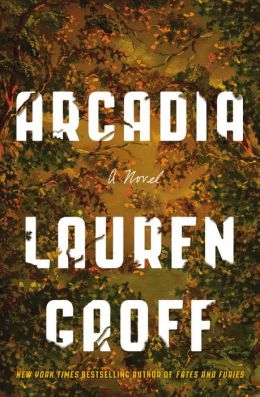
The first half of Lauren Groff's novel Arcadia places itself, and its protagonist, Bit Stone, firmly in the traditions of the American novel, as Bit, like Huckleberry Finn and Jim Burden and so many other American children before him, lives under the vastness of the sky, in the arms of the natural world, and with the promise of a better life of real equality ever just before his grasp:
For a few breaths he forgets himself in the swim of nature around him. Its rhythm is so different from Bit's human own, both more nervous and more patient. He sees a bug that is smaller than a period on a page. He sees the sky, bigger than all that's in his head. An overwhelm from two directions, vast and tiny, together.
The second half of the novel loses Bit to modern life, and as he wanders his way back towards this connection to the land and to his childhood, loses itself a bit, too. Like Bit himself, apart from Arcadia itself, Groff's novel becomes just a bit ordinary:
On the days that he swings through the city on his walks, he can almost grasp what they lost...It was the story they had told themselves from the moment the Dutch had decanted from their ships onto the oyster-strewn island and traded land for guilders: that this place filled with water and wildlife was special, rare, equitable...That this equality of purpose would keep them safe.
Arcadia is a commune in the forest and fields of New York in the 1970's. It is peopled with mythic hippies, included Bit's compelling and fully-realized parents, Hannah and Abe. Born three month premature, tiny Bit grows up in the womb of this not-untroubled, yet gorgeously idyllic world where through his wide and transcendental eyes Groff's reader is brought fully into Arcadia's spell. These years of Bit's life are a reading experience I will not soon forget.
But as utopias must, Arcadia falls, and Bit is sent out into the real world. In the same way that Bit never finds himself quite at home in New York City's streets, the novel itself never regains its purity and focus, wandering as Bit does through modern life without much sense of larger purpose.
Groff's prose gets distracted by a 2018 flu epidemic that has the world on quarantine and that pushes Bit back into the arms of Arcadia. But in a fiction landscape where it seems almost every protagonist finds himself with a similar crisis on his hands, I find myself wishing that Groff, like Arcadia's inhabitants themselves, had kept things more simple.
I wholeheartedly recommend that you read Arcadia. Its spell is powerful. But it will be broken sooner than you wish.
Which I guess might be exactly the point.
Sunday, March 17, 2013
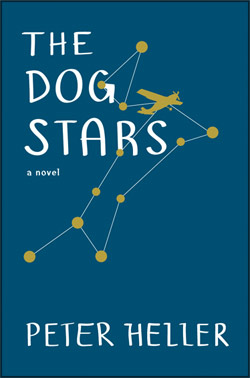
The Dog Stars, by Peter Heller
Upon hearing a synopsis of The Dog Stars by Peter Heller, you might think it has much more in common with The Road by Cormac McCarthy than it actually does: lone man, accompanied only by trusted companion (dog/young son, respectively) navigates terrifying world decimated (is there a word for 1/100? centimated?) by global plague, searching for humanity in a kill-or-be-killed landscape of violence and fear.
But I assure you that The Road is so much unlike The Dog Stars that you should not allow your feelings about that text to impact whether or not you pick up this one. Which is to say: read this if you liked The Road. But especially read it if you didn't.
First of all, can I just say, Peter Heller is a badass. His blog touts him as the "award-winning adventure writer," and, I mean, this guy rode with Whale Wars. And wrote a book about it. He's the real deal.
But it is precisely Heller's hard-won credentials that make the tenderness of his narrator so startling and so authentic.
Our noble and humble hero Hig, accompanied by his noble and humble man's-best-friend Jasper, live in Colorado after a flu wipes out basically the entire human race. Hig's only form of back-up is a solid one: Bruce Bangley, ex-military with an extremely impressive arsenal. Hig flies a 1956 Cessna 182, "really a beaut" he boasts on page 4, scouting the beautiful and empty landscape for signs of humanity. Not just humans. Humanity.
Hig also likes to fish, and he and Bangley get into a bunch of fire-fights, which I pretty much skimmed (like all fight scenes I read, generally) but if you're a boy, you'll probably like them. And during the fight things he says stuff like this:
Heart thumping, but it was the almost happy anxious thump I remembered from playing soccer in high school. I was a goalie, the last stop, the last resort...Once it started it was all action, no thought, and the joy pushed up through the fear.
I've never played goalie, but I know that happy anxious thump. We all do.
And I'm no expert, but I don't really think it's the fight scenes that make this book. Though, if you love fight scenes, please weigh in. Instead, it's the beautifully clipped emotion of Heller's voice. A lot of reviews compare him to Hemingway, but as I see it, Jake Barnes is way more repressed, thwarted, and, you know, impotent, than this guy.
Heller's narrative exemplifies the kind of male voice I want my students to read. It's authentic, honest, emotional, moving, and not ashamed to be attached to things, people, dogs, feelings. Hig needs connection in his life, and he seeks it without compromising even the tiniest fragment of his manhood.
And, amazingly, he finds what's he's looking for, which is more than a little bit unbelievable. But I accepted it, because I liked him so darn much, that I thought, gosh-darn-it, he deserves the sexy beautiful soulmate he happens to find on his quest. (And it really isn't exactly that simple.)
I am interested in our persistent infatuation with apocalyptic and post-apocalyptic fiction, and I feel that because of the ubiquity of the genre, a review of this type of book may get lost in the shuffle.
But I recommend this story not because it feels like one of those stories, but exactly because it doesn't. Hig's connections, with Jasper, with the land, are real, and so is his desire to preserve, and not only preserve, but actively seek those links even when things seem hopeless.
A worthy goal.
Thursday, March 14, 2013
Next Reads
I've been a terrible reader, lately. The truth is, I more often am (a terrible reader) than not. But it's spring break, and here are two books at the top of my list.
Vampires in the Lemon Grove by Karen Russell
I'll admit. I didn't love Swamplandia! And I rarely pick up short story collections, so I wrote this one off pretty quickly. But the always-wise Maureen Corrigan loved it. When she described "Proving Up" as "Willa Cather crossed with Emily Dickinson in her Gothic mood" and argued that it "is a stark tale about the American Frontier and the payment — in sanity and mortality — that the land demanded from the settlers," I was completely won over. Book Riot also loved it, giving "Proving Up" the admittedly unattainable A-triple-plus.
The Round House by Louise Erdrich
Erdrich is one of my absolute favorite authors. If you haven't discovered her, start with Tracks, and then pick up The Last Report on the Miracles at Little No Horse. (With a title like that, how can you go wrong?) I had The Round House in the back of my mind, but Love Medicine didn't totally win me over, so I wasn't convinced.
But then, when Dead White Guys called it "an unexpected whodunit page turner!" I decided it was definitely time to revisit Erdrich. After an admittedly slow reading season, it sounds like exactly the thing to help me start back up.
Sunday, January 27, 2013
Tell the Wolves I'm Home, by Carol Rifka Brunt
There is nothing like a book that can be so sad, and yet make you believe again in how fundamentally good and beautiful everything really is.Tell the Wolves I'm Home is a book like that.
So affirming, so sad, youthful and yet wise. It's all the best things about being a teenager and experiencing the intensity of real love and real loss.
Or being anyone and experiencing the intensity of real love and real loss.
It's not a perfect novel -- but it was that novel that was perfectly what I needed to read right now. Tell the Wolves I'm Home was like getting a letter from a really good friend who wrote to tell you how much you matter.
June Elbus loses her beloved uncle Finn to AIDS in 1986, when the particular cruelties of that diseases were just beginning to stoke fear and ravage lives without mercy.
June is awkward. Incredibly so. She's that kid who dresses like she believes she lives in the Middle Ages. And who, in fact, does like to pretend that she lives in the Middle Ages.
Only her beloved Uncle Finn (the remarkably financially successful artist) sees her. Only he knows her heart. And when she confesses to him one afternoon that she goes to the woods after school to pretend she's in another world:
He laughed and bumped his should against mine...We both knew we were the biggest nerds in the whole world.
When she loses him, she fears total invisibility:
Now that Finn's gone, nobody knows that I go to the woods after school. Sometimes I think nobody even remembers those woods exist at all.
But a few weeks after his death, a visit from a suspiciously unofficial postman starts June on her journey towards discovering that we are all invisible, and that we all need someone to see us. June herself, her seemingly-perfect older sister Greta, her complicated mother, and Finn's partner and love-of-his-life, Toby.
Almost implausibly self-aware June is, at times, also implausibly blind to her sister Greta's jealousy, heartache, and cries for help, but it is her relationship with Toby, a connection so outside the boundaries of what any normal person might expect out of a friendship, that is the driving emotional force of this novel. In losing Finn, they find each other, and together they create that sacred liminal space that all storybook friends know.
In one moment, after spending a magical day with Toby, June sits beside him and muses:
I felt like I had proof that not all days are the same length, not all time has the same weight. Proof that there are worlds and worlds and worlds on top of worlds, if you want them to be there.
Faithful readers of this blog will know that this is one of my most cherished beliefs.
It is difficult, at times nearly impossible, to find those worlds, particularly in moments of grief or loss. But a novel like Tell the Wolves I'm Home can be a very strong start.
Towards the end of the story, Toby tells June about his relationship with Finn. And he asks her:
"He saved me, you know?"
Toby means literally. But he also means in the ways that we are always saving each other -- by seeing one another for our best selves and helping one another to find worlds on top of and within worlds. And so, Dear Reader, does June save Toby; Toby saves June, and they saved me a little bit. Right when I needed it.
If you're not much of a YA fan, this might not be the novel for you. But if, like me, you still believe the best moments are those when you can pretend to be part of some secret, separate world, well, this novel will make your nerd-heart feel it is home.
Sunday, December 16, 2012
On My List
Here's the Christmas List I made yesterday. Christmas Reading List that is.
Drown and This is How You Lose Her by Junot Diaz
Let the Great World Spin by Colum McCann
Literary Science Fiction:
The Wind-up Bird Chronicle by Haruki Murakami
Cloud Atlas by David Mitchell
Mystery:
Faithful Place by Tana French
Gone Girl by Gillian Flynn
Where should I start?
Sunday, November 25, 2012
The Fault in Our Stars: Emotional Sadism
Ok, ok, I just said that to get your attention. But listen:
I love sad stories. I promise. Bridge to Terabithia is my Favorite-capital-F, and The English Patient and Atonement, both films and novels, are to me the epitome of beauty. I raised five years worth of middle school students on Of Mice and Men and Romeo and Juliet, assuring their parents at every Parents Night that their children's emotional lives would only be deepened and enriched, not scarred, by the inevitable tragedy in each of these texts, and now I gleefully teach an eleventh grade curriculum where virtually every text ends in a suicide.
I believe strongly that young readers need to be exposed to these texts. Need to be changed and challenged by the rich and immense griefs which are now an essential thread of our cultural narrative and inevitably part of our own lives. And I indulge, occasionally, in revisiting these texts for some good old-fashioned borderline-masochistic catharsis.
But John Green's monumentally popular, beautifully-titled The Fault in Our Stars is something else entirely.
Now, I say all of this not to disparage John Green or his project. And I am all for anything -- anything -- that gets people to read (I'm talking to you, Stephenie Meyer). And his work is well-written, and delightfully wordy, and his narrative voice is smart and literary and true. So there's that.
And there are children with cancer who need their stories told. And those stories are certainly worth telling.
But I get the sense from TFIOS that Green is not writing for kids with cancer. He is writing for kids who are healthy.
And perhaps it is actually a mark of his success that in so doing, he exposes readers who have never faced real, actual, living, breathing death, either literal or metaphorical (death of a loved one, death of a relationship, death of a dream...I could go on) to Real Death's gaunt and haunting reality.
Readers pick up TFIOS because they want to feel something -- feel something in the way that Romeo and Juliet or Bridge to T. makes them feel. Something real and undeniably important.
In Green's star-cross'd lovers Augustus and Hazel (and they call themselves such, placing themselves and Green's story squarely and self-consciously within that tradition) he artfully builds a new pair of lovers for the ages, lovers who somehow deny and defy their youth through the hospital equipment that literally weighs them down throughout the story and their overpowering awareness of their own mortality and their own legacy.
But Green doesn't just play with the star-cross'd lovers trope. He kills it. And then buries it. And makes it attend its own funeral.
Oh, Hazel and Augustus are likable and smart and all of the wonderful things we hope our protagonists will be. They are Leslie and Jess, Juliet and Romeo, Viola and Shakespeare.
Many people I respect love this book. And I prepared to lose myself within its tragic pages with the total abandon restricted to those most wonderfully sad reads listed above. But, Dear Reader, by the time I was 100 pages in I had to put it down between chapters in order to catch my breath. What I experienced was not the sweet sadness of Lennie's final gaze out into the hills of California or Jess' stoic resolve to live on for what Leslie represented to him, but the actual real pain of facing something truly terrible.
Perhaps this is a mark of Green's success. But as an adult writing for a young adult audience, I wonder about his purpose. Even the adult who has lived the most charmed life has had to face some kind of real loss and the grieving process that follows. A process that sometimes feels a lot more like stasis. TFIOS evoked that kind of loss for me.
By the time Augustus listens to Hazel read his own eulogy, I had to stop altogether.
I don't know. Maybe I just talked myself out of my own argument. But I expected to love this book.
And instead it just brought to mind the real pain and loss I've felt in my own charmed life.
And I can't help but imagine that my seventeen-year-old self wouldn't have known what was happening to her under Mr. Green's skillful hand.
And that makes me sad.
But maybe that's the point.
Am I being hypocritical here?
I love sad stories. I promise. Bridge to Terabithia is my Favorite-capital-F, and The English Patient and Atonement, both films and novels, are to me the epitome of beauty. I raised five years worth of middle school students on Of Mice and Men and Romeo and Juliet, assuring their parents at every Parents Night that their children's emotional lives would only be deepened and enriched, not scarred, by the inevitable tragedy in each of these texts, and now I gleefully teach an eleventh grade curriculum where virtually every text ends in a suicide.
I believe strongly that young readers need to be exposed to these texts. Need to be changed and challenged by the rich and immense griefs which are now an essential thread of our cultural narrative and inevitably part of our own lives. And I indulge, occasionally, in revisiting these texts for some good old-fashioned borderline-masochistic catharsis.
But John Green's monumentally popular, beautifully-titled The Fault in Our Stars is something else entirely.
Now, I say all of this not to disparage John Green or his project. And I am all for anything -- anything -- that gets people to read (I'm talking to you, Stephenie Meyer). And his work is well-written, and delightfully wordy, and his narrative voice is smart and literary and true. So there's that.
And there are children with cancer who need their stories told. And those stories are certainly worth telling.
But I get the sense from TFIOS that Green is not writing for kids with cancer. He is writing for kids who are healthy.
And perhaps it is actually a mark of his success that in so doing, he exposes readers who have never faced real, actual, living, breathing death, either literal or metaphorical (death of a loved one, death of a relationship, death of a dream...I could go on) to Real Death's gaunt and haunting reality.
In Green's star-cross'd lovers Augustus and Hazel (and they call themselves such, placing themselves and Green's story squarely and self-consciously within that tradition) he artfully builds a new pair of lovers for the ages, lovers who somehow deny and defy their youth through the hospital equipment that literally weighs them down throughout the story and their overpowering awareness of their own mortality and their own legacy.
But Green doesn't just play with the star-cross'd lovers trope. He kills it. And then buries it. And makes it attend its own funeral.
Oh, Hazel and Augustus are likable and smart and all of the wonderful things we hope our protagonists will be. They are Leslie and Jess, Juliet and Romeo, Viola and Shakespeare.
Many people I respect love this book. And I prepared to lose myself within its tragic pages with the total abandon restricted to those most wonderfully sad reads listed above. But, Dear Reader, by the time I was 100 pages in I had to put it down between chapters in order to catch my breath. What I experienced was not the sweet sadness of Lennie's final gaze out into the hills of California or Jess' stoic resolve to live on for what Leslie represented to him, but the actual real pain of facing something truly terrible.
Perhaps this is a mark of Green's success. But as an adult writing for a young adult audience, I wonder about his purpose. Even the adult who has lived the most charmed life has had to face some kind of real loss and the grieving process that follows. A process that sometimes feels a lot more like stasis. TFIOS evoked that kind of loss for me.
By the time Augustus listens to Hazel read his own eulogy, I had to stop altogether.
I don't know. Maybe I just talked myself out of my own argument. But I expected to love this book.
And instead it just brought to mind the real pain and loss I've felt in my own charmed life.
And I can't help but imagine that my seventeen-year-old self wouldn't have known what was happening to her under Mr. Green's skillful hand.
And that makes me sad.
But maybe that's the point.
Am I being hypocritical here?
Friday, November 23, 2012
The Great Gatsby
If you get the ambition to pick up a classic this winter, I'm all for it. And if you're diligent and ambitious enough to get through Anna Karenina in preparation for or celebration of Keira Knightley's bodice-ripper, well, good luck with the mowing scene.
But not just because Baz Luhrmann's Gatsby will be released this spring, Gatsby is without a doubt the classic you haven't read since high school that is worth your time. You'll read it on a Saturday or in a weekend, and you will finish feeling transcendent.
What a gem this book is.
The plot is sexy (so sexy!), fast-paced, and devastating. The language is incandescent. The characters are beautiful and damned.
And its lasting impression is at once the building and the destruction of our national myth.
Monday, November 5, 2012
A Post-Catcher World
Emily Temple at Flavorwire proposes these 10 Novels to Replace Catcher in the Rye as the Perfect Teen Book. Looking to pick up something relevant, readable, and new myself, I'm interested. I would also like to add Skippy Dies, Paul Murray's painful paean to teenage angst -- the real kind. It's about ... it's about how "like, people are always going somewhere? Like everybody's always trying to be not where they are?..."
"It's like, you know, inside every stove there's a fire. Well, inside every grass blade there's a grass blade, that's just like burning up with being a grass blade. And inside every tree, there's a tree, and inside every person there's a person, and inside this world that seems so boring and ordinary, if you look hard enough, there's a totally amazing magical beautiful world."
That's what Skippy Dies is about.
Definitely worth it.
Incidentally, I'm about to teach Catcher in a few weeks to ninth graders. Are we, as Emily Temple and Jessica Roake at Slate suggest, living in a post-Catcher world?
Thursday, August 9, 2012
What I Think You Should Take to the Beach
A few people have asked me recently what I think they should pack with them on their August beach trip. I'm only offering a few words on each title, but please, add your thoughts...
Here goes...
Anything by Tana French. Particularly In the Woods. Smart, totally engrossing, psychologically insightful, wonderful characters.
The Lonely Polygamist by Brady Udall is epic, hilarious, and deeply moving. And I loved Rusty more than any character since Owen Meany. I'm going to keep recommending this one til everybody listens...
Just had to make myself put down The Art of Fielding to write this post, and it had me almost crying. A good, old-fashioned, compelling novel.
Beautifully written, a little sci-fi, a little mystery, this novel has been on my favorites list for a long time. It's a little bit of a love story, it's a little bit strange, it's totally gorgeous.
Technically a young adult novel, The Book Thief is one of my favorite reads of all time. And it's long enough to keep you busy for a while. Part graphic novel, it might remind you of a more grown-up Number the Stars -- that moving, that pure.
I'd also add Freedom by Jonathan Franzen, The Age of Miracles, and The Name of the Wind (for fantasy fans) -- those are all reviewed elsewhere on this blog.
Happy Reading! May you find that magical, liminal place between perfect awareness and perfect escape that all the best books bring.
Friday, August 3, 2012
Thoughts turn to school...
I just read Amy Pine's post on Nerdy Book Club about Renewing a Love of Reading in HS Seniors. (Check out her blog, AmyLovesYA.) It is absolutely full of excellent ideas and brimming with inspiration for cultivating a classroom where the love of reading lives all year long -- not just in the summer. (It particularly caught my eye because she loves Divergent as much as I do.)
Why is even the most avid reader among us so quick to lose the magic of books, burying it beneath a pile of house work and school work?
Nerdy Book Club once again just reminded me to retain that magic.
Why is even the most avid reader among us so quick to lose the magic of books, burying it beneath a pile of house work and school work?
Nerdy Book Club once again just reminded me to retain that magic.
Subscribe to:
Posts (Atom)